You already know the concepts. Now you have to pick one.
That is the hard part. On paper, UWB, BLE, and GPS all promise to tell you where something is. In practice they answer very different questions, at very different price points, with very different accuracy. Choose wrong and your prototype either bleeds budget or never hits the precision your project needs.
So this is not a “which technology is best” article. No single technology wins everywhere. The honest answer is that the right choice depends on one thing above all: where your assets move, and how tightly you need to pin them down.
Here is the short version.
Use GPS when things move across wide outdoor spaces. Use BLE when you only need rough zones and want to keep costs low. Use UWB when you need real coordinates indoors, down to the centimeter. The rest of this guide shows you how to make that call with confidence, and where each option quietly falls apart.
The quick comparison
This table is the fastest way to see the trade-offs. Everything below just explains it.
| UWB | BLE (Beacon) | GPS | |
|---|---|---|---|
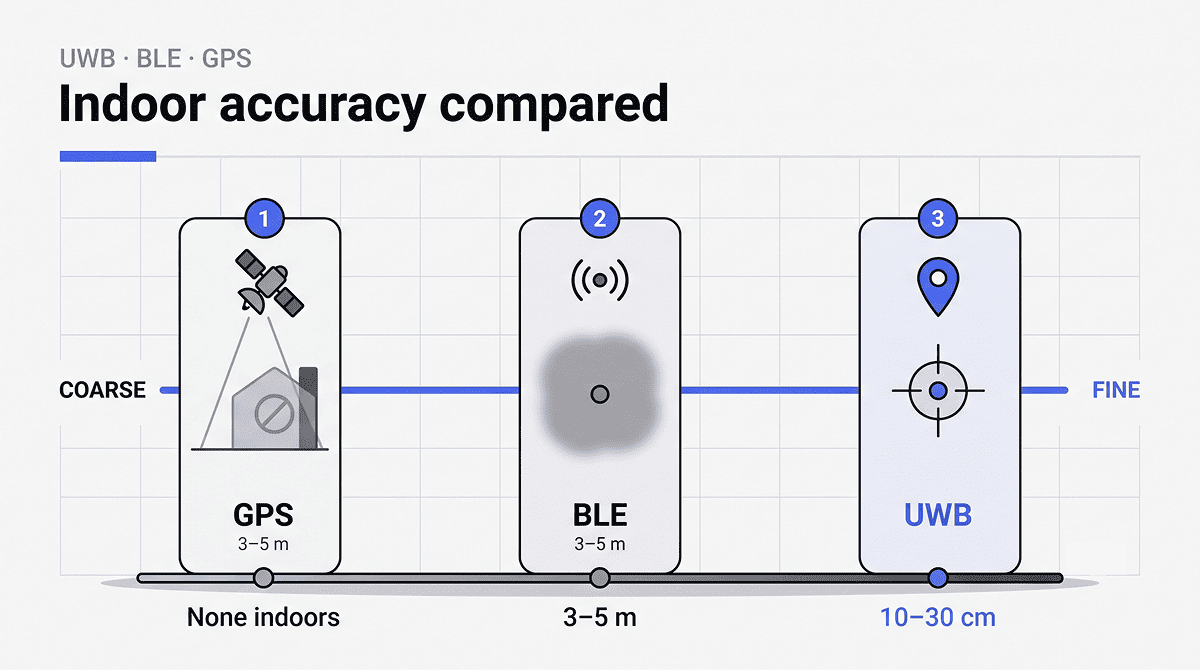
| Accuracy | 10–30 cm | 3–5 m (zone level) | 5–10 m outdoors, unusable indoors |
| Indoor performance | Precise, real coordinates | Rough proximity only | Effectively none |
| Outdoor performance | Works, but built for indoors | Works for proximity | Its home turf |
| Cost & scalability | Higher hardware, scales cleanly | Cheapest to start | Free signal, receiver-only |
| Install difficulty | Anchors need mounting and setup | Drop beacons and go | Zero install outdoors |
| Privacy acceptance | High: collects a point, not a face | High: proximity only | High: device-side |
| Typical use | Asset tracking, worker safety, robotics | Retail proximity, coarse presence | Vehicles, logistics on the move |
One more option deserves a mention: Wi-Fi positioning. It reuses access points you already own, which is its main appeal. Accuracy usually lands in the same 3–15 m range as BLE, and it drifts hard around metal and concrete. For most indoor precision work it sits in the same “good enough for zones” bucket as BLE, so we will fold it in there.
UWB vs BLE: what’s the difference for indoor positioning?
BLE tells you near which beacon a device is. UWB tells you exactly where the device is. That gap is the whole story.
BLE positioning reads signal strength. A phone or tag hears a beacon, measures how loud it is, and guesses distance from that. The trouble is that signal strength wobbles. A person walking past, a metal shelf, a closed door, all of it changes the reading. So BLE gives you a zone, usually 3 to 5 meters wide, not a point. That is fine if you want to know a shopper entered the electronics aisle. It falls short the moment you need to know where a forklift is within arm’s reach of a worker.
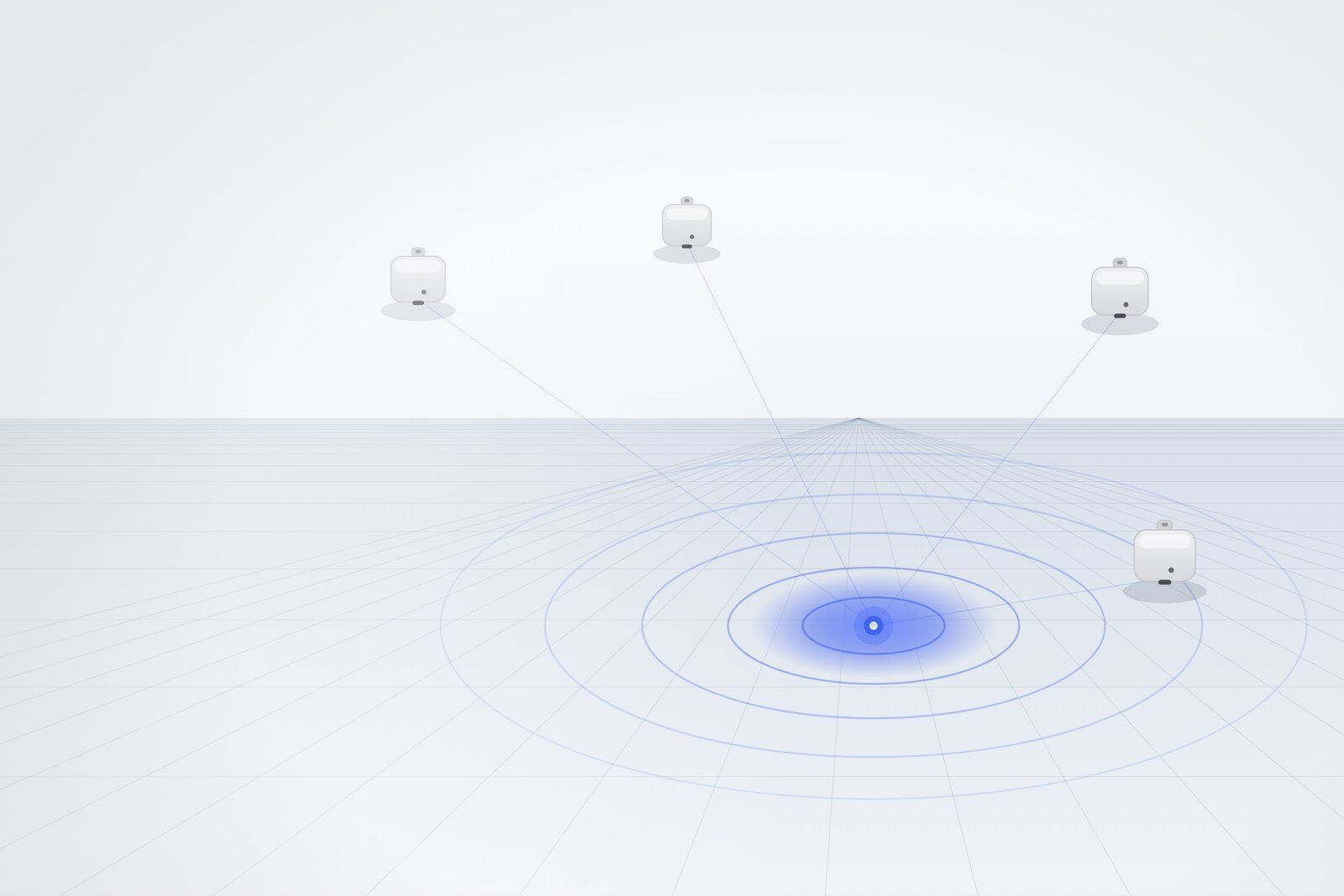
UWB works differently. It measures the actual flight time of a radio pulse between a tag and fixed anchors, then triangulates. Time, not signal strength. Because the pulses are extremely short and span a wide band (3.1 to 10.6 GHz), the timing is precise, and so is the position. That is how UWB lands at 10 to 30 cm indoors.
There is a catch, and it is only fair to name it. UWB needs anchors mounted around the space, so setup takes more effort than tossing out a few beacons. You are trading install work for precision. Whether that trade is worth it comes down to how much the extra accuracy actually buys you.
UWB vs GPS: why not just use GPS indoors?
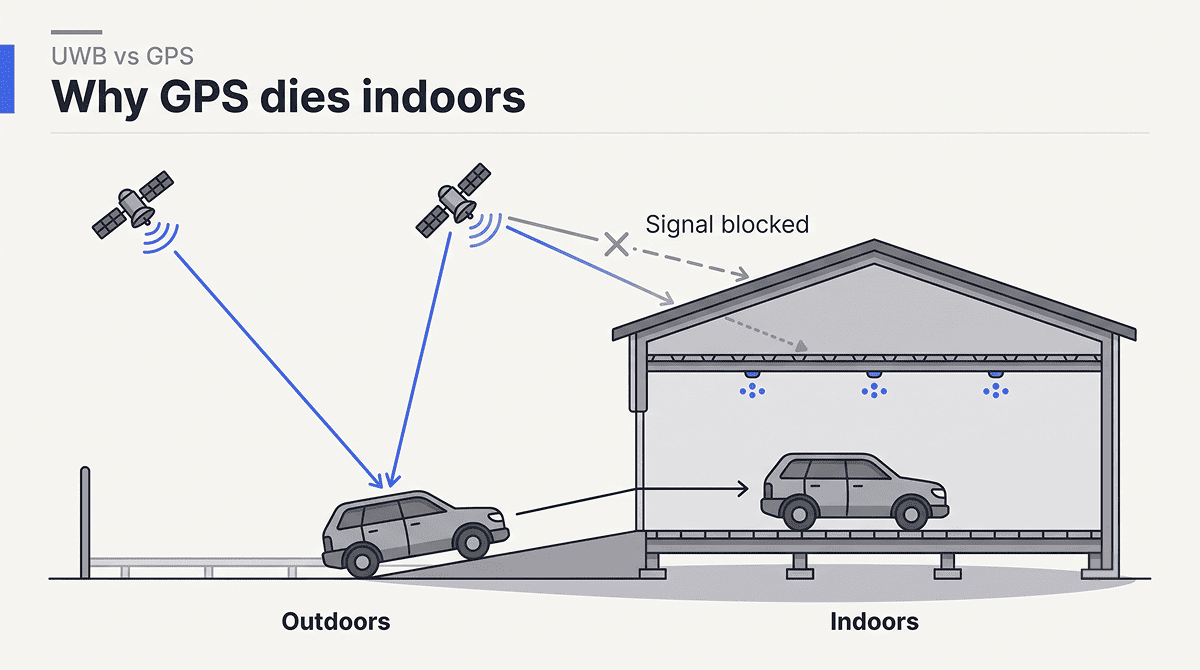
Because GPS cannot see the sky from inside a building. That is the entire problem.
GPS positions come from satellites overhead. The signal is faint by the time it reaches the ground, and a roof, a steel frame, or a concrete deck stops it cold. Step inside a warehouse and your coordinates dissolve into noise. This is not a tuning issue you can fix with a better antenna. The physics simply do not work indoors.
Outdoors, GPS is excellent, and nothing here disputes that. For a truck crossing a city or a fleet moving between sites, GPS is the obvious choice and UWB would be pointless. But the question was about indoor positioning, and indoors GPS gives you nothing to build on.
This is why hybrid setups exist. A vehicle can ride on GPS across an open yard, then hand off to UWB the moment it rolls under a canopy or into a building. We run exactly that kind of pairing at metal-dense industrial sites, where outdoor GPS and indoor UWB cover one continuous space between them.
Which is most accurate for indoor positioning?
UWB. It holds 10 to 30 cm indoors, while BLE gives you 3 to 5 m and GPS gives you nothing usable inside.
That is an order of magnitude, not a rounding difference. Thirty centimeters versus three meters changes what you can actually do. At 3 to 5 m you can say a worker is “somewhere in this bay.” At 10 to 30 cm you can tell that the same worker just stepped inside a danger zone around a moving machine, and trigger an alert before contact. Precision is not vanity here. It decides which use cases are even possible.
The gap widens in ugly environments. Metal reflects radio signals, and those reflections confuse ordinary positioning: the tag looks like it is in two places at once, and error can blow out to several meters. This is the real test, because most industrial floors are full of steel.
Our own CIR algorithm handles this by filtering out the reflected copies and reading only the direct path from tag to anchor. That is where the numbers hold up. At one metal-dense automotive-logistics site, packed with thousands of parked vehicles, a fusion setup held accuracy to 23.05 cm. That setup paired UWB with RTK-GPS and an IMU, so keep one thing straight: the 23.05 cm figure comes from the fused system, not from UWB on its own. A UWB kit by itself lands under 30 cm, and that is the range to expect when you run the kit on your desk. Field runs across more than 40 industrial deployments back up how it holds in metal-heavy conditions. Radio also carries another quiet advantage over cameras: it reaches through dust, through low light, and past obstacles that would blind an optical system.
Which is cheapest and easiest to start with?
BLE, without much argument. Beacons are inexpensive, the setup is trivial, and you can be reading proximity data the same afternoon.
Credit where it is due. If your project only needs coarse presence, “is this asset in room A or room B,” then BLE is genuinely the smart call. You drop beacons, no mounting math, no anchor coordinates, and the hardware cost per point is low. Paying for UWB precision you will never use is just waste.
GPS is arguably even easier outdoors, since there is nothing to install at all. The satellites are already up there and the signal is free. Your only cost is the receiver.
UWB asks more of you up front. You mount anchors, enter their coordinates, and give the space a short setup. It is not hard, but it is not zero either. The payoff is that the same precision that makes setup deliberate is also what lets the system scale cleanly from a desk prototype to a full floor without changing approach. You are not choosing “easy versus hard.” You are choosing how much precision the job actually demands.
When should you choose UWB over BLE or GPS?
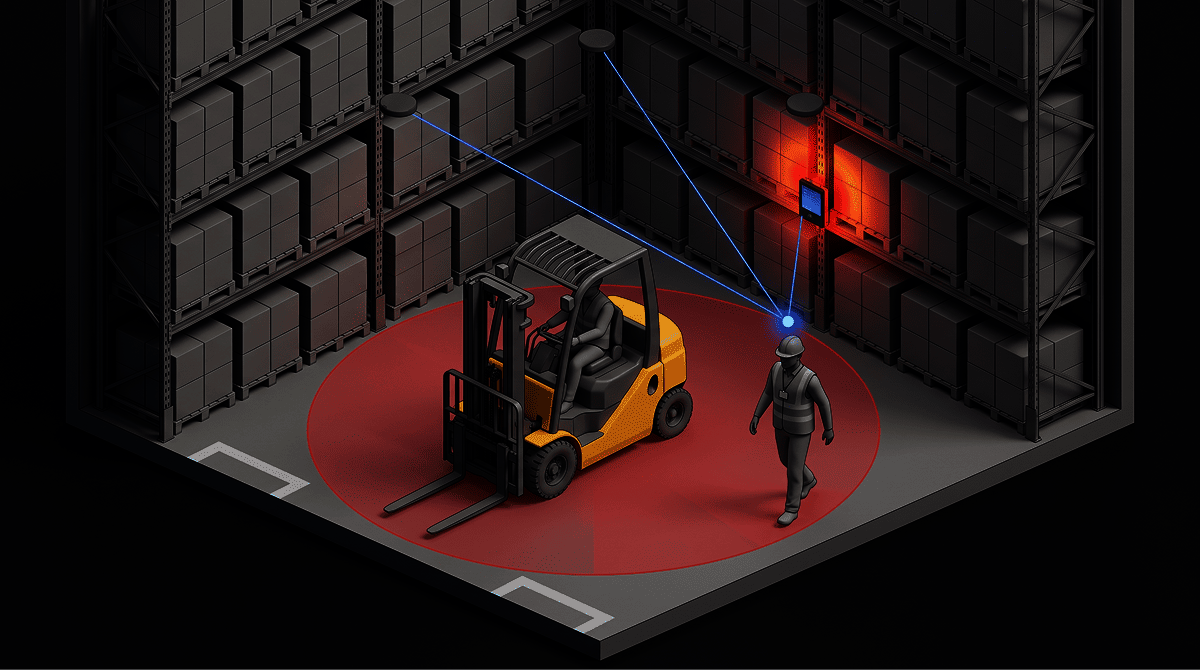
Choose UWB when three things are true at once: you are indoors, you need real coordinates rather than zones, and rough proximity is not good enough. If any one of those drops away, a lighter option probably wins.
Run it through a few honest questions.
Are your assets mostly outdoors and on the move? GPS, and don’t overthink it.
Do you only need to know which room or zone something is in, and is budget tight? BLE. You will not miss the extra precision, and you will save real money.
Do you need to know where something is within centimeters, indoors, in real time? That is UWB territory, and the other two cannot follow it there.
The industrial cases lean UWB for a reason. Worker safety needs to know exactly when someone crosses into a danger zone. Forklift-and-pedestrian collision avoidance needs tight distance, not a fuzzy zone. Robotics needs a real coordinate to move toward. Asset tracking in a dense warehouse needs to find the right pallet, not the right aisle. In each case, three meters of uncertainty breaks the whole point.
There is also a softer reason UWB tends to clear internal reviews. It collects a coordinate, a point on a map, and nothing else. No face, no video, no image. Compared with camera-based tracking, that makes it far easier to get people comfortable with being tracked at work, because the system literally cannot see them, only where their tag is.
A quick reality check on the market
If you are wondering whether UWB is a safe long-term bet, the direction of the market is worth a glance. The global real-time location systems market sat at roughly USD 5.84 billion in 2024 and is projected to reach about USD 15.67 billion by 2030, growing around 18.6% a year (MarketsandMarkets, 2025). Estimates vary a lot between research firms, so treat the exact figures loosely. The trend is the steady part.
Within that market, UWB stands out as the fastest-growing technology, precisely because of its centimeter-level precision (MarketsandMarkets, 2024). Asia-Pacific leads the growth, with Korea, Japan, and China among the main drivers. In other words, the accuracy advantage this article keeps pointing at is the same thing pulling investment toward UWB.
FAQ
Yes, and plenty of real deployments do. GPS outdoors handing off to UWB indoors is common for vehicles and logistics. BLE and UWB can also coexist, using cheap beacons for coarse zones and UWB only where centimeter precision earns its cost.
It can. Reflections off steel throw ordinary systems off by several meters. This is why the algorithm that separates the direct signal from its reflections matters more than the raw hardware spec on a factory floor.
Less than people expect. You mount a few anchors, feed the position data into your code over a serial (UART) connection or an MQTT subscription, and you are reading coordinates. It talks over plain serial or MQTT, so any language you like works fine.
UWB records a coordinate, not a camera feed. Because it captures only a point on a map, it usually meets less resistance than optical tracking when you bring it to the floor.
Making the call
No technology here is the villain, and none is the hero. GPS owns the outdoors. BLE owns cheap, coarse presence. UWB owns precise indoor coordinates, and once you need centimeters inside a building, the other two quietly stop being options.
So map the choice to your problem, not to a spec sheet. Where do your assets move? How precisely do you need to pin them? Answer those two honestly and the technology picks itself.
If your answer is “indoors, and I need real precision,” UWB is where you start.
Ready to build with it?
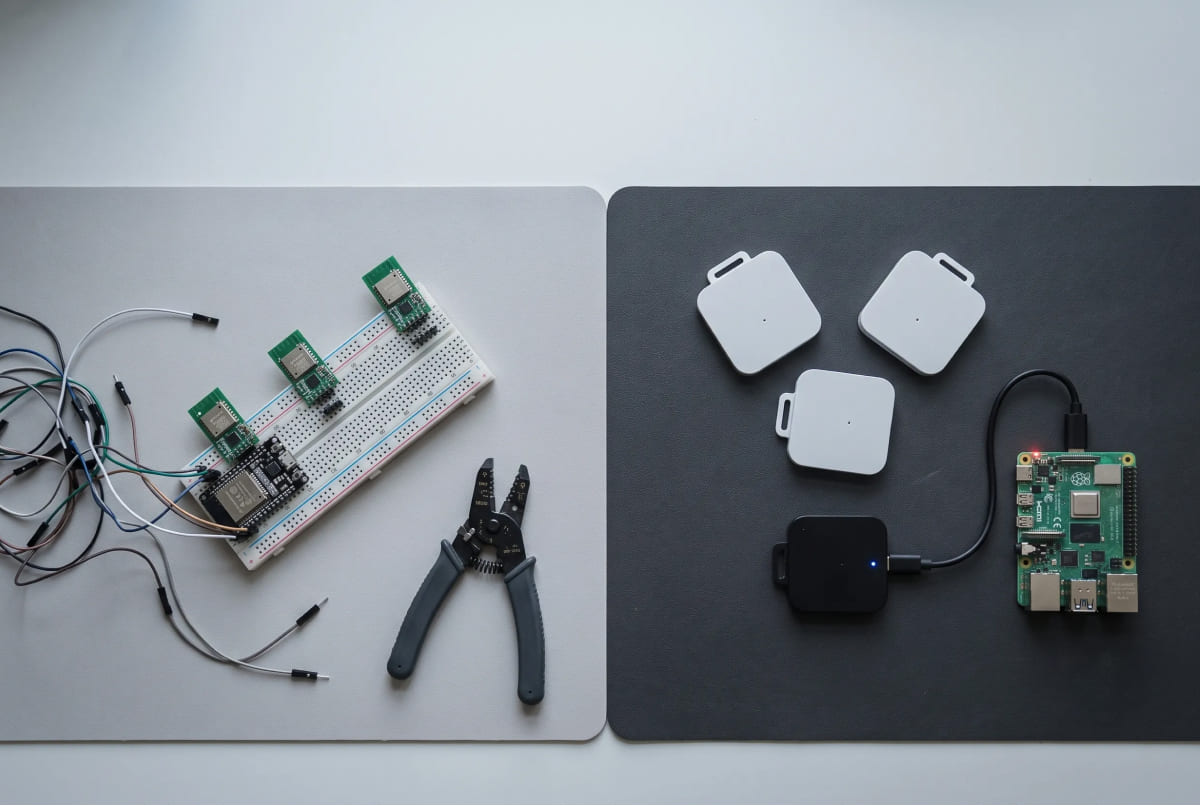
The Creator Kit gives you anchors, a tag, and a listener so you can read live coordinates on your own desk before you commit to a full site. See the Creator Kit →
Want to get hands-on first?
Walk through our guide on wiring it up: UWB Positioning with Arduino. Prefer Python? UWB on Raspberry Pi with Python is on the way.
New to the whole topic?
Start with the fundamentals in UWB Indoor Positioning — A Beginner’s Guide, then come back here for the head-to-head. For build details and pinouts, our setup guide lives on GitBook.