We are living in an era where technology and space are becoming increasingly interconnected. In particular, real-time location information is rapidly evolving to optimize space and improve operational efficiency.
At the core of this transformation is real-time location tracking, commonly known as RTLS (Real-Time Location System).
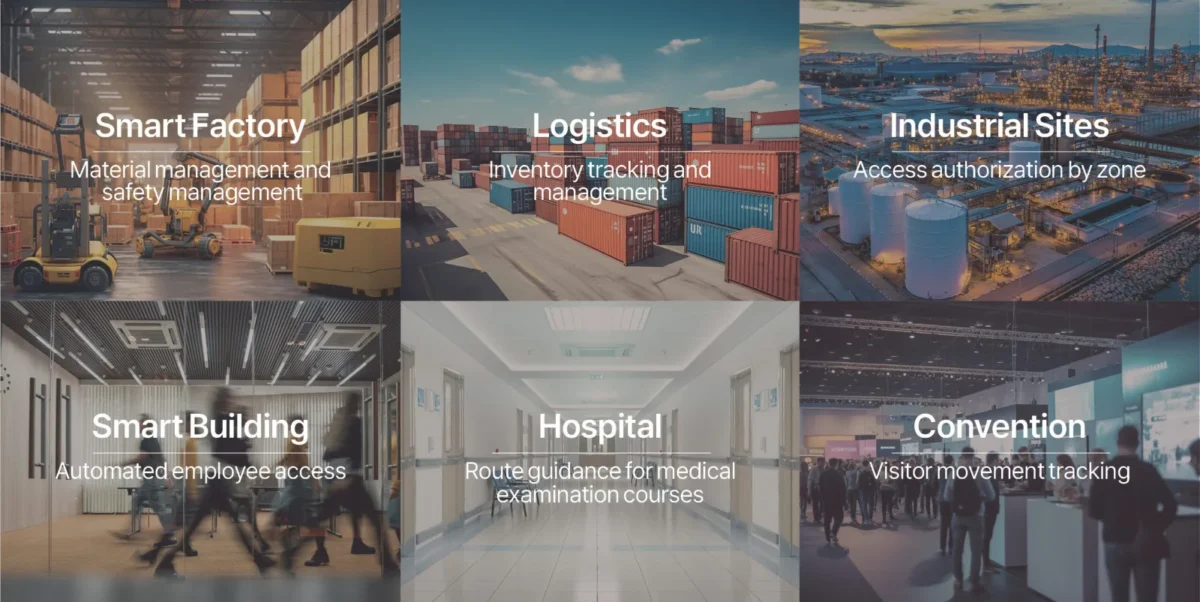
RTLS is a key technology that enhances operational efficiency by tracking and analyzing the real-time location of assets and people across various industries, including logistics warehouses, hospitals, smart buildings, manufacturing plants, exhibitions, and amusement parks.

In this article, we will explore the concept of RTLS, how it works, industry applications, and how GrowSpace is leveraging this technology to deliver innovative solutions.
A forklift backs into a blind corner. A worker steps around a pallet rack. Nobody sees the other coming until it’s too late. That’s the problem RTLS solves. RTLS stands for Real-Time Location System. It’s a way to track where people, vehicles, and equipment are, updated continuously, inside spaces where GPS doesn’t reach. Warehouses, factory floors, hospital wards, ports. Anywhere with a roof over it, basically. GPS works outdoors because satellite signals travel in a straight line down to a receiver. Put a steel roof and a few rows of racking in the way, and that signal degrades fast. Indoors, GPS error can run past 10 meters. That’s not “off by a little.” That’s off by an entire aisle. RTLS fills that gap using different physics: radio signals bounced between fixed anchors and small tags, measured for distance and triangulated into a position. No satellites involved. If you are comparing technologies, our guide on UWB vs BLE vs GPS for indoor positioning breaks down the trade-offs in detail. For a technical overview of the underlying radio technology, see the Wikipedia entry on Ultra-Wideband (UWB).
How Real-Time Location Tracking (RTLS) Actually Works
Most RTLS setups share the same basic shape. Anchors get mounted at fixed points around a space, usually the ceiling or high on a wall. Tags get attached to whatever needs tracking: a person’s badge, a forklift, a pallet, a wheelchair. The anchors and tags exchange radio signals, and software converts the timing or signal strength of those exchanges into X, Y coordinates. The technology behind that exchange varies a lot, and the choice matters more than most buyers expect.Comparing RTLS Technology Options
Wi-Fi and Bluetooth (BLE) are cheap and easy to deploy. Most buildings already have Wi-Fi access points. But signal strength is a poor proxy for distance. A signal that bounces off a metal shelf reads the same as one that traveled twice as far. Typical accuracy lands in the 2-5 meter range, which is fine for “which zone is this in” but useless for anything more precise. RFID answers a narrower question: is this tag near this reader, yes or no? Passive RFID has no real-time tracking ability at all. It just confirms presence when a tag passes within range, the same way a toll booth confirms a car passed through. It’s a good fit for inventory checks, not for continuous location. UWB (Ultra-Wideband) sends extremely short radio pulses across a wide frequency band. Because the pulses are so short, the system can time their arrival with nanosecond precision, which is where centimeter-level accuracy comes from. UWB also tends to punch through the interference that trips up Wi-Fi and BLE, because the signal isn’t relying on strength alone. It’s reading the actual shape of the arriving waveform. One detail that separates good UWB deployments from mediocre ones: TWR versus TDoA. TWR (Two-Way Ranging) has the tag and anchor go back and forth confirming timing with each other. That’s accurate, but power-hungry, since every measurement is a two-way conversation. TDoA (Time Difference of Arrival) flips that: the tag only transmits, and the anchors, which are wired to power rather than battery, do the listening and the math. Tag battery life stretches from months to years under TDoA, which matters a great deal once a deployment reaches hundreds of tags.| Technology | Typical Accuracy | Works Through Metal/Clutter | Real-Time Tracking |
|---|---|---|---|
| GPS | 10m+ (outdoors only) | No | Yes |
| Wi-Fi / BLE | 2-5m | Poor | Yes |
| Passive RFID | Presence only | Moderate | No |
| UWB | Centimeter-level | Yes | Yes |
Where Real-Time Location Tracking Actually Gets Used
Logistics and yards. A large vehicle logistics yard is exactly the environment that breaks weaker positioning tech: metal vehicle bodies everywhere, reflective surfaces, constant movement. In one automotive logistics site GrowSpace measured directly, UWB positioning held at 23.05cm accuracy despite that interference. That’s the difference between “somewhere in this row” and “third car from the end.” Manufacturing. Jigs, molds, measurement tools, and carts get moved constantly on a factory floor, and none of it gets logged anywhere. RTLS turns “where’s the fixture we used last week” into a lookup instead of a 20-minute search, and it builds a movement history that didn’t exist before. Healthcare and care facilities. Wandering is a real safety risk in memory care units and hospital wards. RTLS geofencing alerts staff the moment a patient or resident crosses a boundary they shouldn’t. The same system tracks mobile equipment, wheelchairs and infusion pumps included, so nobody wastes a shift hunting for a machine that’s actually two floors down. Worker safety around heavy equipment. Forklifts and pedestrians share aisles in nearly every warehouse, and blind corners are where collisions happen. Proximity-based alerts, tag on the worker, tag or anchor on the vehicle, warn both sides before they meet. GrowSpace’s SpaceGuard system applies this specifically to collision and pinch-point prevention, and in Korea it qualifies for a KOSHA safety-equipment subsidy covering up to 80% of the cost.What GrowSpace Actually Builds
GrowSpace runs on UWB with TDoA positioning, tuned specifically for the metal-heavy, cluttered environments where cheaper systems fall apart. The system reads channel impulse response data, essentially the fine-grained shape of the incoming signal, to filter out reflections and multipath noise that would otherwise corrupt a position reading near steel racking or vehicle bodies. Deployment isn’t a box you install yourself. GrowSpace runs consultation, layout design, on-site installation, and ongoing operation as one continuous process, usually starting with a proof-of-concept in a single zone before scaling to a full site. A PoC deployment doesn’t get thrown away once the real system goes in, it becomes the starting layer that the full rollout builds on.FAQ
Does RTLS work in a building full of metal shelving? It depends entirely on the technology. Wi-Fi and BLE degrade badly near metal and reflective surfaces. UWB, especially systems that process channel impulse response like GrowSpace’s, is built to handle exactly that environment. How accurate is UWB RTLS in practice, not on a spec sheet? GrowSpace measured 23.05cm accuracy in a real automotive logistics yard. Not a lab, not a clean test room. An actual working site with metal vehicle bodies and constant movement. Do I need to replace my existing systems to add RTLS? No. RTLS deployments typically integrate with existing MES, WMS, or CCTV systems rather than replacing them. The location data becomes another input those systems can use. Can I start small before committing to a full site? Yes. Most GrowSpace deployments start as a single-zone PoC. The anchors and configuration from that phase carry forward into the full rollout instead of getting discarded. Curious whether RTLS fits your site? Talk to GrowSpace about a proof-of-concept.PLANNING A DEPLOYMENT?
Which setup fits your site?
GrowSpace designs real-time location tracking (RTLS) around the conditions of your factory, warehouse or construction site — installation, integration with existing systems and ongoing operation handled by one team.