
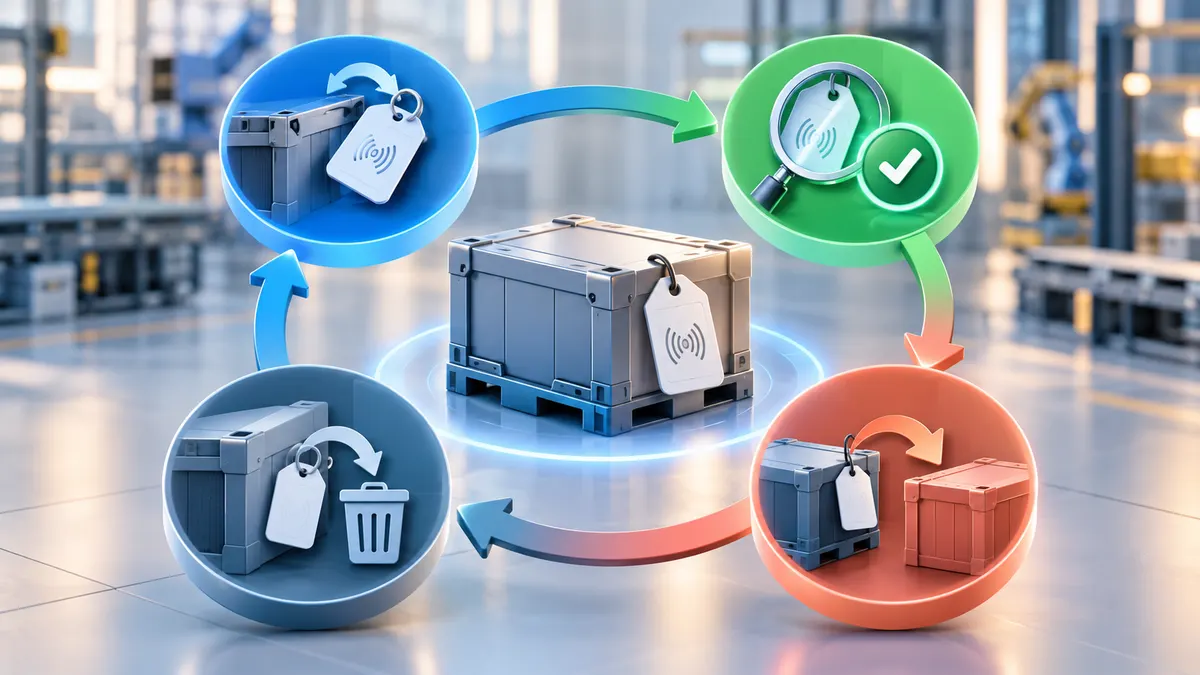
RTLS integration with WMS or MES needs a dependable relationship between the source tag and the business object the application uses. Define who creates that relationship, when it becomes valid, how replacements work and what happens to history. Otherwise, technically valid coordinates can update the wrong equipment, fixture or job.
This article focuses on identity and responsibility after position data is available. The mapping tables and lifecycle below are application design proposals. They are not Q1 payload fields or a claim of a prebuilt WMS connector.
Begin with the business object
A warehouse or production system may distinguish equipment, containers, fixtures, stock units, orders and work-in-progress. Decide which object the tag physically represents.
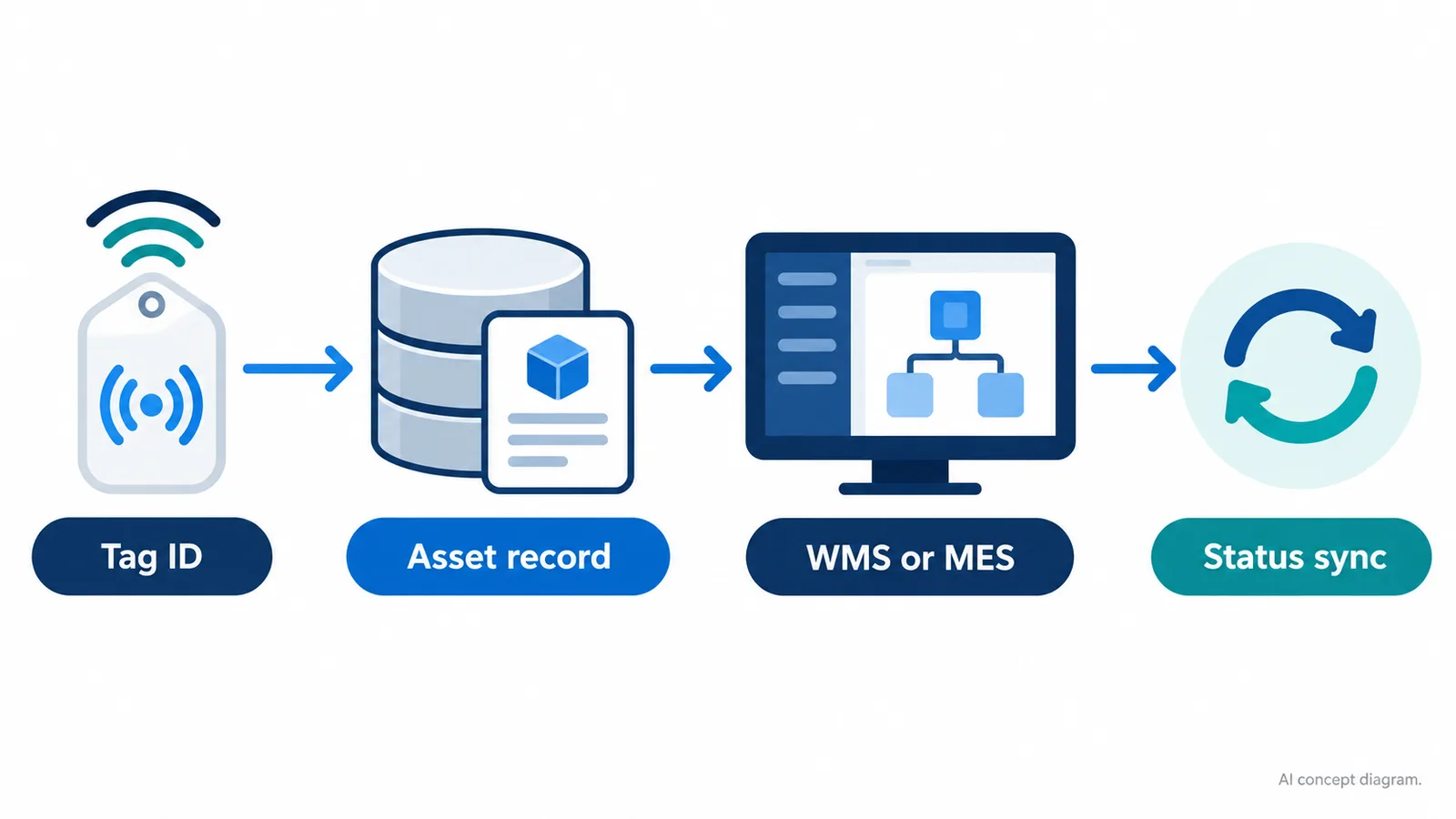
A tag fixed to a reusable container locates that container. To locate a particular stock unit through it, the integration also needs a valid record linking the stock to the container during the relevant period. The same issue appears when a fixture is reused for successive jobs.
Write the operational question precisely. “Where is container C?” is different from “Which order is on container C?” and “May this order be released?” The latter questions depend on records and rules beyond the position stream.
The GrowSpace English FAQ on the homepage, checked on 6 October 2026, describes MQTT coordinate delivery with further development for ERP, MES or WMS integration. It does not describe a ready-made direct connector. Confirm the target-system interface and implementation scope for the specific project.
Decide which system owns each identity
Agree a source of truth for each record before writing synchronization logic.
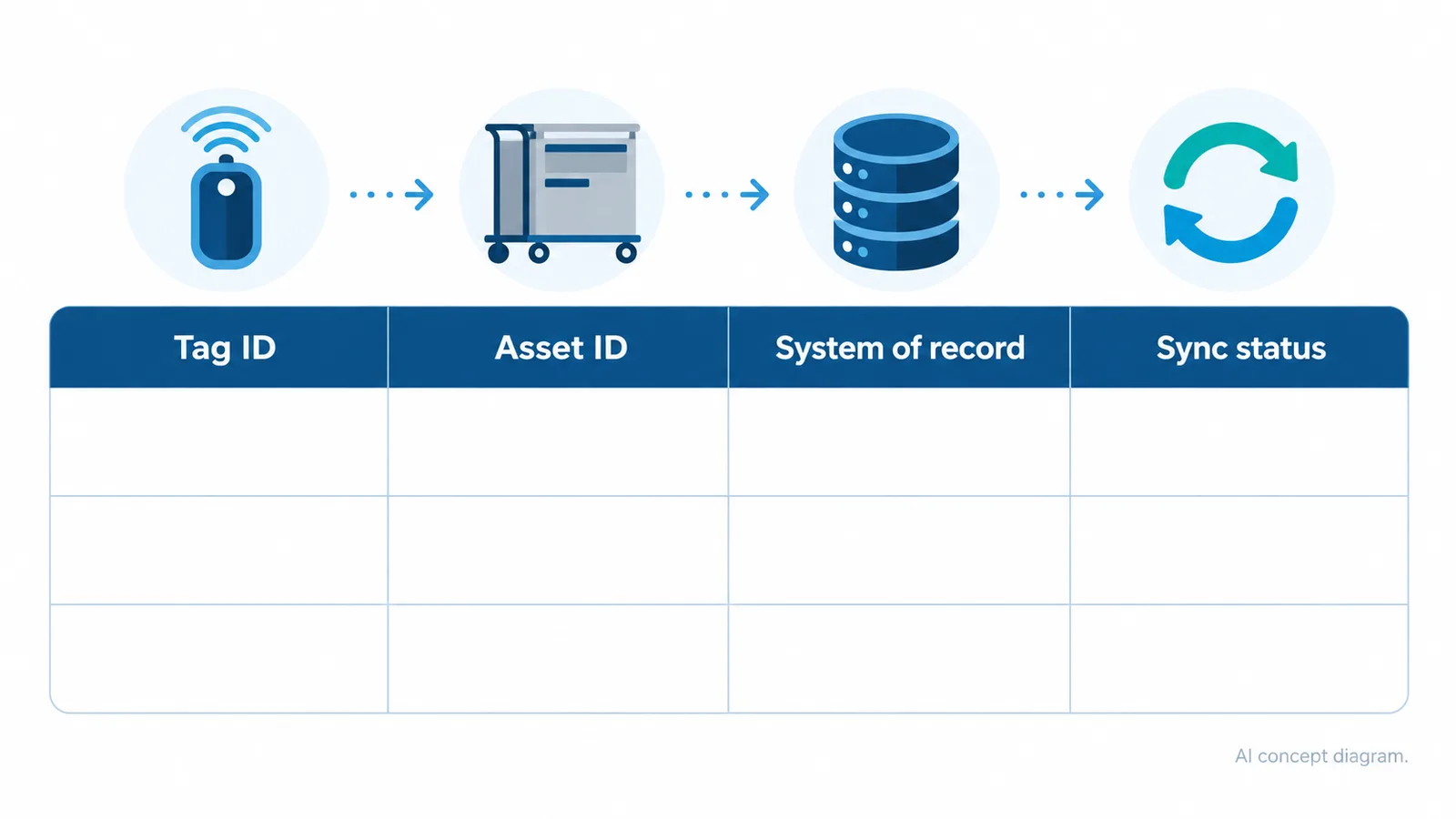
| Record | Owner to establish | Decision that needs an answer |
|---|---|---|
| Source tag identity | Device inventory owner | How is a physical device uniquely recognized? |
| Business asset identity | WMS, MES or asset-master owner | Which ID remains stable through device replacement? |
| Tag-to-asset assignment | Named operational or integration owner | Who can create, verify and end an assignment? |
| Container-to-content or fixture-to-job relationship | Relevant business-system owner | What evidence establishes the current relationship? |
| Zone identity | Layout or application owner | How are physical areas mapped to business locations? |
| Derived event | Integration application owner | What evidence and rule version produced it? |
Use documented source identifiers from the actual device stream. Do not assume that a tag ID alone is globally unique, or normalize it in a way that could merge distinct devices. Agree the namespace using the verified data contract.
Make assignments effective over time
A current mapping is enough for a simple live lookup only while no late data, replacement or historical query creates ambiguity. For an integration that needs history, define when an assignment starts and ends.
The following identifiers and times are entirely synthetic. They are application records, not a Q1 packet capture. Assume the example uses an inclusive start and exclusive end, in UTC.
| Source tag reference | Business asset | Effective from | Effective until | Assignment state |
|---|---|---|---|---|
| Test tag A | Test rig 01 | 08:00 | 12:00 | Closed after removal |
| Test tag B | Test rig 01 | 12:05 | Open | Active after verification |
| Test tag A | Test rig 02 | 13:00 | Open | Active after reassignment |
The five-minute interval after 12:00 is deliberately unassigned for Test rig 01 in this example. Do not fill that gap by extending an assignment merely to keep a report continuous.
For a delayed position record, the integration needs a trustworthy time basis to select the historical assignment. If the source does not provide a verified observation time, receiver time may be insufficient to establish which asset carried the tag when the observation was made. Define a hold or review route for that uncertainty.
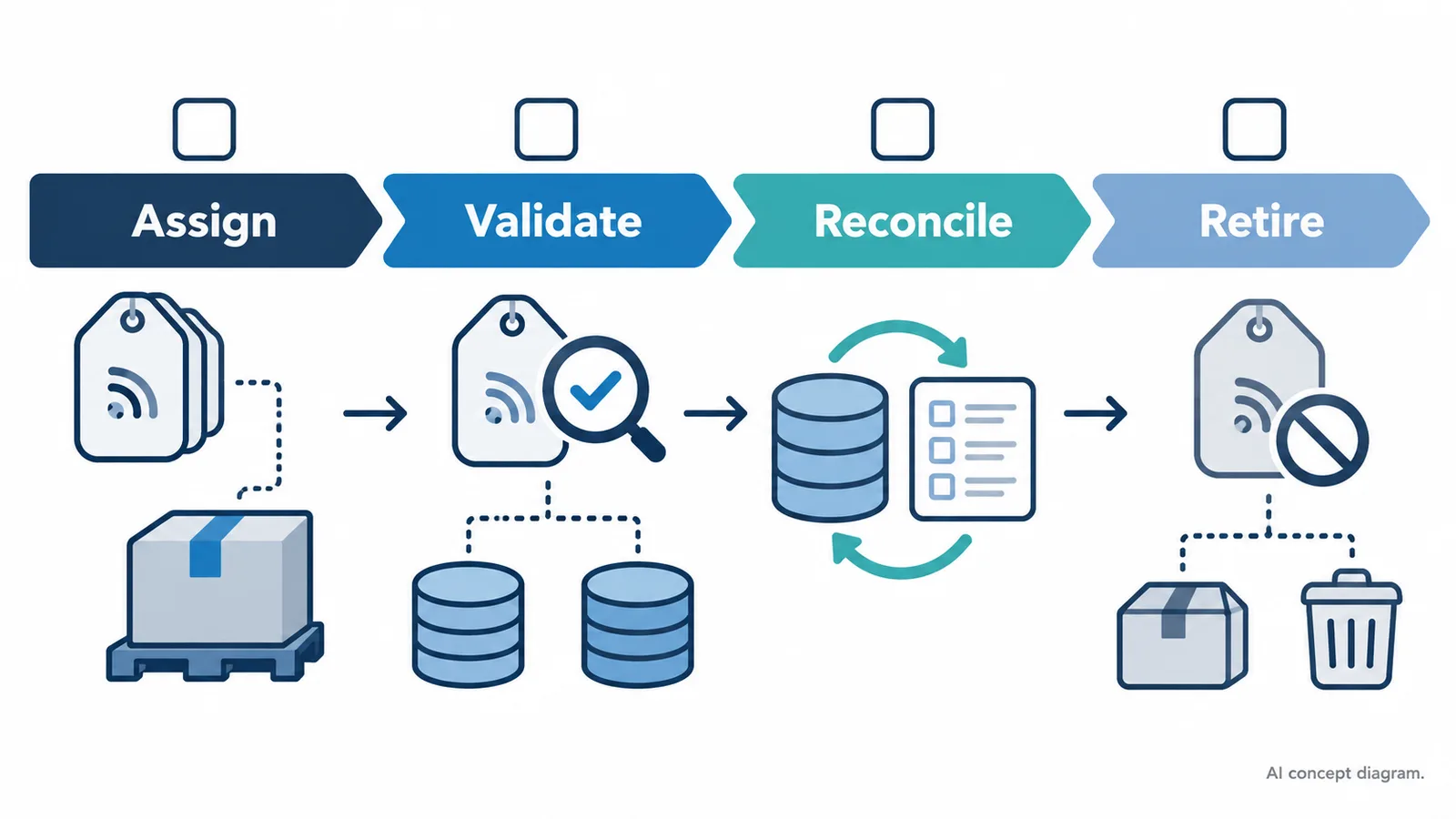
Rehearse the lifecycle
Attach and register. Identify the physical tag and the business asset through the agreed operational process. Record who or what created the assignment and the relevant evidence. A software entry alone cannot establish that the tag was attached to the intended object.
Validate. Check that the application label and an observed movement correspond to the intended asset. Make the verification step practical enough to perform consistently.
Replace. Close or suspend the old assignment, record the replacement and validate the new relationship. Preserve the old device’s history rather than overwriting its identifier everywhere.
Reassign. Confirm removal from the previous asset before creating the new assignment. Handle overlapping or contradictory assignments explicitly.
Retire. Mark the device or asset inactive under the agreed procedure. Decide what the consumer should do if a retired source still reports, while preserving history according to policy.
Handle ambiguity before it reaches inventory
Choose an explicit application behavior for these cases:
- One tag appears to have two active asset assignments
- Two tags are assigned to an asset that is expected to have one
- A recognized tag reports with no current assignment
- An asset record has been merged, renamed or retired in the business system
- A container moves while its content relationship is unknown
- A delayed event arrives after the relevant job or transfer has closed
Flagging or quarantining uncertain records may be more useful than forcing a match. The operations owner should be able to resolve the problem without editing raw coordinates or deleting the historical evidence.
Separate location evidence from a business transaction
A zone-entry event can inform an operator that a fixture reached a work area. Automatically posting a stock transfer or changing a production state is a separate behavior that needs agreement from the business-system owner.
Before including writeback, define the permitted operation, required evidence, duplicate handling, failure handling and reconciliation process. Confirm the target API, credentials and permissions through the organization’s approved integration process. MQTT delivery does not establish those permissions or guarantee that the target system accepted a change.
A useful first test can keep location observations and proposed events visible for review alongside the existing business record. Use the discrepancies to refine identity and event rules before relying on automation.
Give the integrator a clear scope
Provide an anonymized asset-master sample, source identifier examples, the assignment workflow and the business event you want to support. Add the rules for replacements, late records and exception resolution. State which team owns the target interface and whether the scope is read-only visibility, proposed events for review or approved transactions.
Planning an RTLS-to-WMS or MES integration? Review your identifiers and event requirements with GrowSpace. Start with one concrete lifecycle, such as replacing a tag on a reusable fixture, and make the ownership and acceptance criteria explicit before expanding the integration.
Related posts
- Forklift Proximity Warning or RTLS Tracking? Questions for a Safety-System Brief
- Freegrow Completes Development of Geomagnetic-Based RTLS Algorithm
- Freegrow Selected for Regional Innovation Scale-Up Program by the Ministry of Science and ICT and the Innovation Cluster Foundation
- Freegrow Selected for DIPS Advanced Manufacturing Track, Evolving Its Single UWB Positioning Device Into Integrated Land-and-Sea Hardware