Most RTLS quotes look identical on paper. Every vendor claims centimeter accuracy, every datasheet lists similar update rates, and every sales deck shows the same warehouse floor plan with glowing dots moving across it. Then the system goes live on a factory floor full of steel racks and forklifts, and the numbers stop matching the brochure.
A real-time location system, or RTLS, tracks the position of tags attached to people, vehicles, or assets, usually to within centimeters or meters depending on the technology behind it. That single-sentence definition hides a lot of variation. Wi-Fi-based RTLS and UWB-based RTLS both get called “RTLS,” but a facility manager who picks the wrong one ends up rebuilding the deployment a year later.
This guide walks through the four things that actually separate a working RTLS from an expensive pilot that never scales: technology choice, accuracy under real conditions, tag economics, and integration effort.

Which positioning technology actually fits your site?
Four technologies show up in almost every RTLS comparison: BLE, Wi-Fi, UWB, and GPS-RTK. They are not interchangeable.
| Technology | Typical accuracy | Best fit | Weak point |
|---|---|---|---|
| BLE (Bluetooth beacons) | 1–3 m | Zone-level presence, low-cost proximity | Accuracy drops further near metal shelving |
| Wi-Fi (existing AP infrastructure) | 3–5 m | Coarse tracking on a network you already own | Update rate is slow, unusable for collision alerts |
| UWB (ultra-wideband) | Centimeters | Forklift safety, asset tracking, worker positioning indoors | Needs its own anchor infrastructure |
| GPS-RTK | Centimeters, outdoors only | Yard, port, and open-lot vehicle tracking | Signal disappears indoors and under structures |
GPS does not work indoors. Satellite signals cannot pass through a roof, so any site that needs positioning inside a building has to look at BLE, Wi-Fi, or UWB instead. Wi-Fi and BLE are usually good enough for “which zone is this pallet in.” Neither is good enough for “will this forklift hit that worker in the next two seconds,” because both the accuracy and the refresh rate are too low for that decision.
UWB (ultra-wideband) closes that gap. It operates across a wide radio band, roughly 3.1 to 10.6 GHz, and measures signal timing precisely enough to place a tag within centimeters rather than meters — commonly cited as 10 to 20 times more precise than Wi-Fi, BLE, or GPS in the same space. That precision is why UWB has become the fastest-growing RTLS technology on the market, according to MarketsandMarkets’ 2025 RTLS market report.
Datasheet accuracy and real-world accuracy are different numbers
Here’s what most buyers miss.
A UWB kit spec sheet will usually list sub-30cm accuracy. That number comes from open, line-of-sight testing. Put the same hardware inside a warehouse packed with steel shelving, or a manufacturing floor lined with metal presses, and the signal starts bouncing off every surface it hits. Reflected signals arrive at the receiver slightly after the direct signal, and a positioning engine that can’t tell the two apart reports a location that’s off by meters, not centimeters. That’s the gap between a demo and a deployment.
The fix is filtering, not more anchors. GrowSpace uses a proprietary CIR (channel impulse response) algorithm that reads the timing profile of the incoming signal and keeps only the direct path, discarding the reflected echoes before they get counted. In a PoC at a large automotive parts logistics site in South Korea — thousands of vehicles, dense metal racking, heavy non-line-of-sight interference — that filtering held real-world accuracy to 23.05 cm.
One clarification worth making explicit: that 23.05 cm figure comes from a fused positioning stack — UWB plus RTK-GPS plus IMU — running together across an indoor-outdoor site, not from a UWB tag on its own. The standalone kit spec is still sub-30cm. Ask any vendor for their number under metal interference, not just their open-field number. If they can’t answer, that’s the answer.

Tag cost decides whether the rollout scales
A pilot with twenty tags hides a cost problem that a rollout of two thousand tags exposes immediately.
Legacy RTLS hardware — proprietary radio stacks, closed vendor lock-in, per-tag licensing — tends to push per-tag pricing into a range that makes plant-wide coverage a budget conversation, not an engineering one. GrowSpace’s build cost runs at roughly one-fifth of a legacy RTLS deployment, and its UWB tags cost around 300 KRW each, close to a sixth-hundredth of typical tag pricing in the category. At that unit cost, tagging every pallet becomes a realistic plan instead of a pilot that never leaves the pilot phase.
Battery life matters just as much as unit price, especially for worker-worn tags that get swapped, charged, and lost. A TDOA (time difference of arrival) positioning mode only requires the tag to transmit a signal — it never has to listen for one back. That one change cuts power draw sharply and stretches replacement cycles, which matters a lot once a few thousand tags are in the field instead of twenty.
Getting a straight answer on integration
The last question buyers forget to ask: what does this system talk to on day one?
An RTLS that only draws dots on its own dashboard solves half a problem. The other half is getting positioning data into whatever system already runs the floor — an MES tracking production, a WMS managing inventory, or a safety platform flagging near-misses. A vendor who can’t describe that integration path in one sentence probably hasn’t built it yet.
Frequently asked questions
Does UWB work outdoors as well as indoors?
UWB is built for indoor use. Outdoors, satellite-based GPS-RTK is the right tool, and a site that spans both — say, a warehouse yard plus the building itself — usually needs both technologies fused together rather than one stretched to cover the other.
How many anchors does a UWB deployment need?
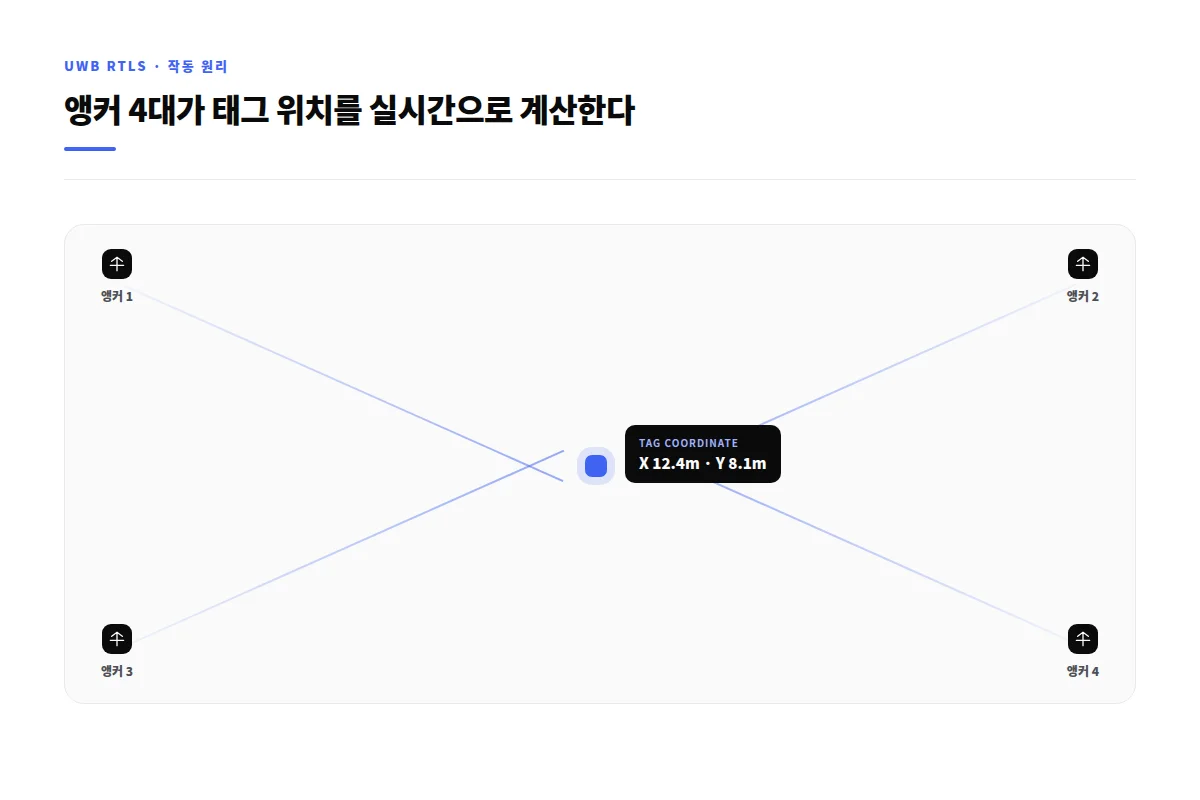
It depends on what’s being measured. Distance alone needs one anchor. A flat X-Y position needs three or more. Adding height (a Z-axis) needs four.
Is centimeter accuracy always necessary?
No. Zone-level tracking (which aisle, which room) is a BLE or Wi-Fi job and costs far less. Centimeter accuracy earns its price when the use case is collision avoidance, precise asset location, or safety-critical worker positioning — situations where a few meters of error defeats the purpose.
Next step
A datasheet comparison only gets a buyer halfway. The number that matters is accuracy measured on a floor that looks like the one being deployed on — metal, congestion, and all.
Request a site-specific accuracy estimate based on your facility layout and tag count.
함께 보면 좋은 글
- [Growspace Studio API Series #2] Get & Update Place Details: API Guide You Can Use Right Away
- What is RTLS? Principles and Applications of Real-Time Location Tracking
- [Raspberry Pi Practice] GrowSpace UWB Tag Integration Guide – How to Receive Position Data
- [Part 1] GrowSpace UWB Serial Connection Guide – From Installing Tera Term to Initial Setup